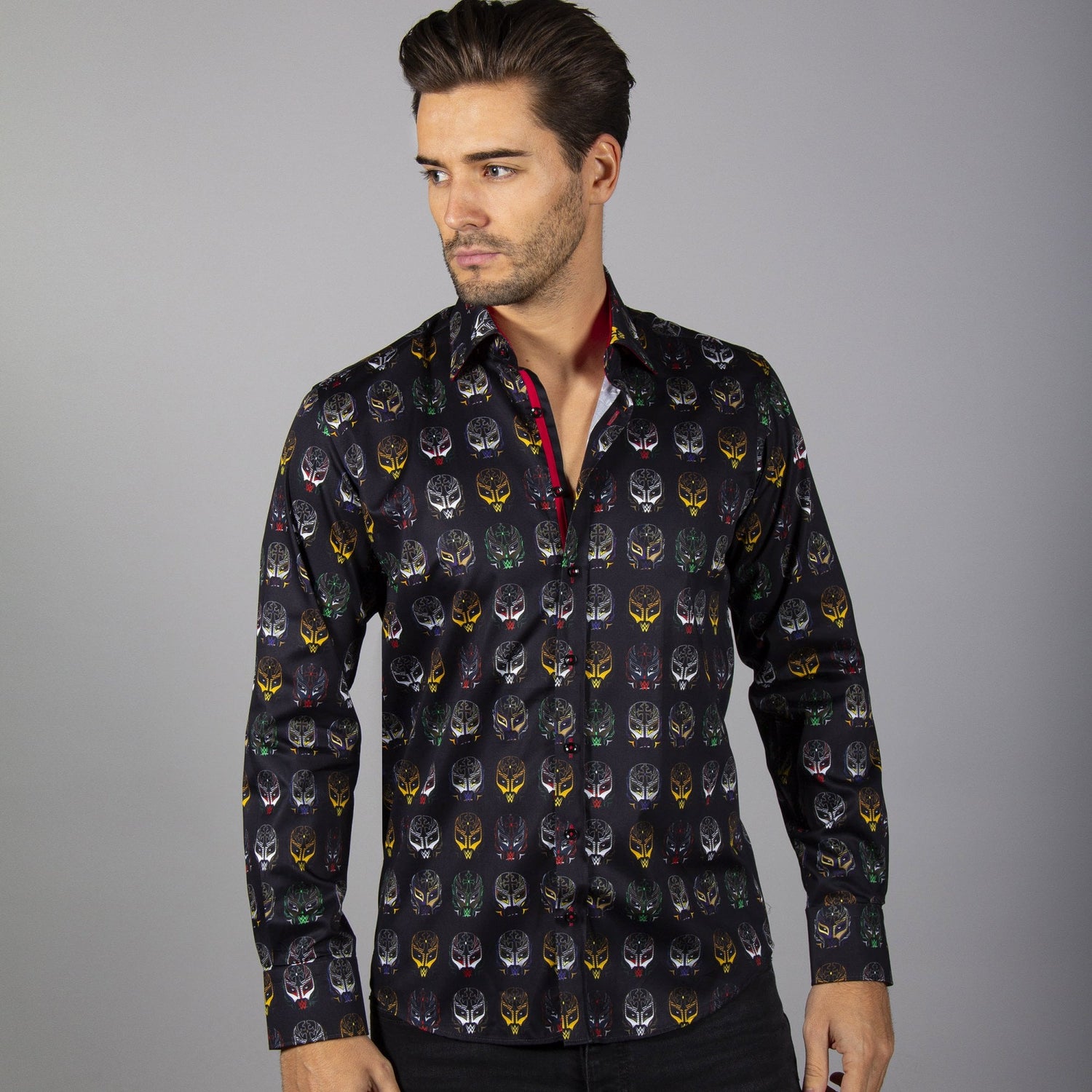
Read the eras through costume design
For a fashion-focused reading of wrestling, compare how an outfit works at three distances: its silhouette across an arena, its colour on television and the detail in a close-up. Entrance coats create scale, masks make a face instantly recognisable, and simple logos can carry a faction identity.
Our interpretation is about visual design rather than ranking careers. Use the official archive to check dates and appearances, then compare the dedicated mask, robe and faction articles below. Merchandise inspired by an era is a separate product question: inspect the actual listing, size information and stated licensing rather than assuming that a historical article proves a product’s rights or availability.
Read next
- WWE Eras Explained: A Complete Guide From Golden Age to Today
- Greatest Masked Wrestlers & the History of the Mask
- Ric Flair and the Art of Wrestling Extravagance
- nWo: How a Faction Became an Iconic Visual Identity
Sources: WWE: official history timeline.
Explore style, culture and collaborations in the Claudio Lugli journal.
Professional wrestling has never only been about what happens between the ropes. Long before a bell rings, a Superstar has already told you who they are — through a mask, a robe, a streak of face paint, a logo, a colour, a walk down the ramp. Wrestling is one of the few art forms where identity is worn before it is ever spoken.
That is the idea behind the Claudio Lugli WWE Icons Collection: a set of officially licensed shirts that treat wrestling's greatest characters as what they always were — visual icons. This is a look back at the legends, the looks and the moments that turned Superstars into cultural landmarks, and at how their imagery carries into statement shirting today.
When wrestling created an icon
Picture the most recognisable figures in wrestling history and you rarely see a hold or a finish first. You see a look. Hulk Hogan's red and yellow. The nWo's black and white. Sting's painted face. A luchador's mask. Wrestling worked out early that character is communicated visually — through costume, colour, typography, entrance music and, above all, merchandise.
That last point matters more than it seems. For decades the T-shirt has been how fans declare which side they are on. Wrestling merchandise is tribal: you wear the logo of the wrestler, the faction, the era you belong to. Walk into any arena and the crowd is a living scoreboard of allegiances. It is fandom made wearable — which is precisely where a fashion house earns the right to join the conversation, provided it does so with respect for the history rather than a shortcut through it.

The era of larger-than-life characters
The template for the modern wrestling icon was set in the 1980s and early 1990s, when the business leaned fully into spectacle. Hulk Hogan built an empire — Hulkamania — on primary colours, torn vests and a pointing finger the whole arena could follow. The Ultimate Warrior sprinted to the ring in neon and face paint, all crackling energy and cryptic promos that made no literal sense and total emotional sense. “Macho Man” Randy Savage layered on sequins, tassels, cowboy hats and wraparound shades until he looked like a rodeo emperor, and growled every word as if it cost him something.
These men were not dressed like athletes. They were dressed like characters, and the audience started dressing like them in return. Two figures from that world still headline the Claudio Lugli collection, because their style was as sharp as their psychology: “Rowdy” Roddy Piper and “Nature Boy” Ric Flair. We will come to both. The point for now is the shift itself — the moment wrestling decided that how you looked was as important as what you did.
Rebellion, attitude and a new kind of fan
By the late 1990s the tone had changed entirely. The period commonly known as the Attitude Era — broadly from the late 1990s to the WWF's rename to WWE in 2002, though fans still argue over the exact starting line — was louder, edgier and more rebellious than anything before it. It was fuelled by the Monday Night Wars, the head-to-head ratings battle between WWF's Raw and WCW's Nitro that pushed both companies to take bigger, riskier swings every single week.
Anti-authority was the mood of the age. “Stone Cold” Steve Austin built the era's defining catchphrase almost by accident — “Austin 3:16 says I just whipped your ass” — and turned two-fingered defiance of his own boss into the most popular act in the company. D-Generation X reduced rebellion to a chant and a crude two-word invitation. The content got sharper, the language got bluer, and television as a whole was drifting away from the family-friendly toward the edgier — wrestling simply ran at the front of that wave. And in the middle of it stood a third-generation Superstar who had once been booed out of buildings, about to become the most charismatic performer the business had ever produced.
Read the full story: the Attitude Era, explained.
The People's Champion: The Rock
Dwayne Johnson did not begin as The Rock. He arrived at Survivor Series in 1996 as Rocky Maivia — a name stitched together from his father, Rocky Johnson, and his grandfather, Peter Maivia — and was pushed hard as a smiling, clean-cut, third-generation hero the crowd was told to love. They refused. “Rocky sucks” rang around arenas; some signs got crueller than that. It is one of wrestling's great origin stories precisely because of what he did with the rejection.
He turned heel, joined the Nation of Domination, and found his voice — arch, arrogant, impossibly quick. He began referring to himself in the third person, cocked a single eyebrow that became its own piece of branding, and built an arsenal of catchphrases fans still finish for him: the People's Champion, the Great One, the Brahma Bull, and the immortal “If you smell what The Rock is cooking.” For a stretch he was the finest talker the industry had. Ten world championship reigns and a global film career later, he remains one of the most recognisable faces wrestling has ever exported to the mainstream.
Which Claudio Lugli Rock shirt is for you?
The collection carries two very different tributes, so it is worth knowing which suits you.

The Rock Legend — bold, proud, fan-first graphics. Choose it if you want the statement read from across the room.

The Rock Icon — a high-impact, all-over print. Choose it if you like your fandom woven through the whole shirt.
Read the full story: The Rock, from Rocky Maivia to the People's Champion.
nWo: when a faction became a visual language
Some of wrestling's most powerful imagery was never about a single person. On 7 July 1996, at WCW's Bash at the Beach, Hulk Hogan — the red-and-yellow hero of a generation — turned his back on the fans and revealed himself as the mysterious third man alongside Scott Hall and Kevin Nash. As the ring filled with rubbish thrown by a betrayed crowd, the New World Order was born, and with it one of the most recognisable brands in wrestling history.
One detail matters to real fans: the nWo was a WCW creation, not a WWE one, though WWE now owns that history (and the faction would later appear in WWE in 2002). What made it endure was not only the storyline but the design. The stark black-and-white logo, spray-painted onto belts, banners and anyone who got in the way, said exactly what the group stood for — outsiders, rule-breakers, a gang rather than a roster. “nWo 4 Life” became shorthand for a whole attitude. The T-shirt became a genuine pop-culture phenomenon that sold in volumes wrestling had never seen, and its monochrome language still echoes through streetwear today.

Read the full story: how the nWo built an iconic visual identity.
The Heartbreak Kid: Shawn Michaels
Few performers matched swagger and skill like Shawn Michaels. “The Heartbreak Kid” — a nickname suggested to him by Curt Hennig — built a career on charisma, showmanship and a genuine claim to being one of the finest in-ring performers of all time; the nicknames “The Showstopper” and “Mr. WrestleMania” were earned, not gifted. A founding member of D-Generation X and a multiple-time WWE Champion, he helped invent the modern ladder match and turned his entrances into events in themselves.
His career had a genuine second act, too: a serious back injury forced him out at the end of the 1990s, and many assumed he was finished. He returned in 2002 and produced some of his best work, before a career-ending loss to The Undertaker at WrestleMania in 2010 gave him one of the sport's most graceful exits. He has been inducted into the WWE Hall of Fame twice.

Read the full story: Shawn Michaels and the showmanship of wrestling.
The mystery of the mask: Rey Mysterio and lucha libre
In lucha libre, the Mexican wrestling tradition, the mask is sacred. It is not a costume; it is an identity. It carries heritage, family and honour, and to lose it in a Lucha de Apuestas — a mask-versus-mask match, the highest stakes a luchador can wager — is among the most serious things that can happen to a wrestler. Few performers embody that better than Rey Mysterio.
His story has real drama. Mysterio lost his mask in WCW, in a match against Kevin Nash, and wrestled unmasked for years — a period he has spoken about with obvious pain, feeling the company never understood what the mask meant to him, his family and his fans. When he joined WWE in 2002 he did something almost unheard of: he asked the lucha libre commission for permission and put the mask back on, reclaiming an identity that tradition says can never be regained. Fans understood instantly what it meant. He has since worn, by his own account, more than a thousand masks — the single motif that turned one of the smaller men in the company into a genuine, larger-than-life, real-life superhero, and proved that presence has nothing to do with size.

The mask was never a disguise. It was the point.
Read the full story: why Rey Mysterio's mask became a symbol. See also our guide to the greatest masked wrestlers and the history of the wrestling mask.
Sting and the power of transformation
Sting spent the bulk of his career as WCW's franchise player before finally joining WWE in 2014, and his story is one of reinvention. For years he was “Surfer” Sting — bleached-blond hair, bright multicoloured face paint, boundless babyface energy. Then, in 1996, to stand alone against the nWo, he transformed completely: monochrome black-and-white paint, a long black coat, a baseball bat and total silence, watching from the rafters and descending only when it mattered. The look drew openly on the 1994 film The Crow, and it remains one of the most striking character overhauls wrestling has ever produced — proof that a new coat of paint, quite literally, can rewrite who a character is.

Read the full story: Sting and the power of a silent, painted identity.
Ric Flair and the art of wrestling extravagance
If any wrestler was made for a fashion retrospective, it is “Nature Boy” Ric Flair. A sixteen-time world champion by WWE's count — titles won mostly across the NWA and WCW before his WWE years — Flair built a persona on pure, gleeful excess: the fur-lined, hand-sequinned robes worn to the ring since the late 1970s, the strut, the “Woo!”, and the self-description that told you everything — “the jet-flying, limousine-riding, kiss-stealing, wheelin'-dealin' son of a gun.” His challenge to every rival became a piece of folk wisdom: “To be the man, you gotta beat the man.”
There is steel under the sequins. Flair survived a 1975 plane crash that broke his back and was told he might never wrestle again; he came back and defined an era. He understood, better than almost anyone, that wrestling is theatre and that clothing is character — his robes were not accessories but statements of status. That is a language a fashion house speaks fluently.

Read the full story: Ric Flair and the art of wrestling extravagance.
Hot Rod: Roddy Piper and the power of the outsider
“Rowdy” Roddy Piper — “Hot Rod” — was wrestling's great agitator. Billed from Glasgow and striding out in a kilt to bagpipes, he pioneered the in-ring talk show with “Piper's Pit,” a segment so unpredictable it could turn on a single moment — as Jimmy Snuka discovered in 1984 when Piper introduced a coconut to the back of his head. He headlined the very first WrestleMania in 1985, teaming with Paul Orndorff against Hulk Hogan and Mr. T, and delivered one of the great villain lines: “Just when they think they have the answers, I change the questions.”
He crossed into the mainstream too, memorably in John Carpenter's cult film They Live, and is widely regarded as one of the greatest heels the business ever produced. He was inducted into the WWE Hall of Fame in 2005. Piper's genius was that you could not look away from him — exactly the quality a statement shirt is built to borrow.

From wrestling merchandise to wearable fandom
Wrestling fans have always worn their allegiances. The graphic T-shirt has done that job faithfully for decades, and it always will. The Claudio Lugli WWE Icons Collection is not an argument against it — it is a different proposition for a different moment.
These are officially licensed WWE shirts, cut as premium statement pieces in satin cotton, designed in London and made to be worn well beyond the arena — to the bar, the party, the night out. Not a replica tee. Not fancy dress. A considered piece of print shirting that happens to carry the iconography you grew up on. If you are buying for someone who owns every wrestling T-shirt going, that difference is the whole point — something we get into in our guide to WWE gifts for fans who already own the tees. And if you simply like bold print, it sits comfortably alongside the rest of our men's printed shirts.
Wear the era
Masks, robes, face paint, black-and-white logos, catchphrases and larger-than-life identities — these are the things that turned wrestlers into icons, and the things fans have always wanted to wear. The Claudio Lugli WWE Icons Collection simply interprets that fandom through a sharper garment.
New to wrestling history, or want the whole timeline in one place? Start with our complete guide to WWE's eras.
Explore the full officially licensed WWE Icons Collection and find the legend that speaks to you.
WWE shirts: FAQs
Are Claudio Lugli WWE shirts officially licensed?
Yes. The Claudio Lugli WWE Icons Collection is officially licensed WWE merchandise, produced under licence and designed in London in premium satin cotton.
Which WWE Superstars are in the collection?
The current range features Rey Mysterio, The Rock (in two designs), Ric Flair, Shawn Michaels, Sting, “Rowdy” Roddy Piper and the nWo.
Are the shirts a good gift for a wrestling fan?
They are ideal for the fan who already owns the standard tees and wants something more grown-up — an officially licensed, premium satin-cotton statement shirt they can wear out, not just to the sofa.
Are they available in the UK?
Yes — the collection ships from the UK, with the same premium satin-cotton make and tailored fit as the wider Claudio Lugli range.