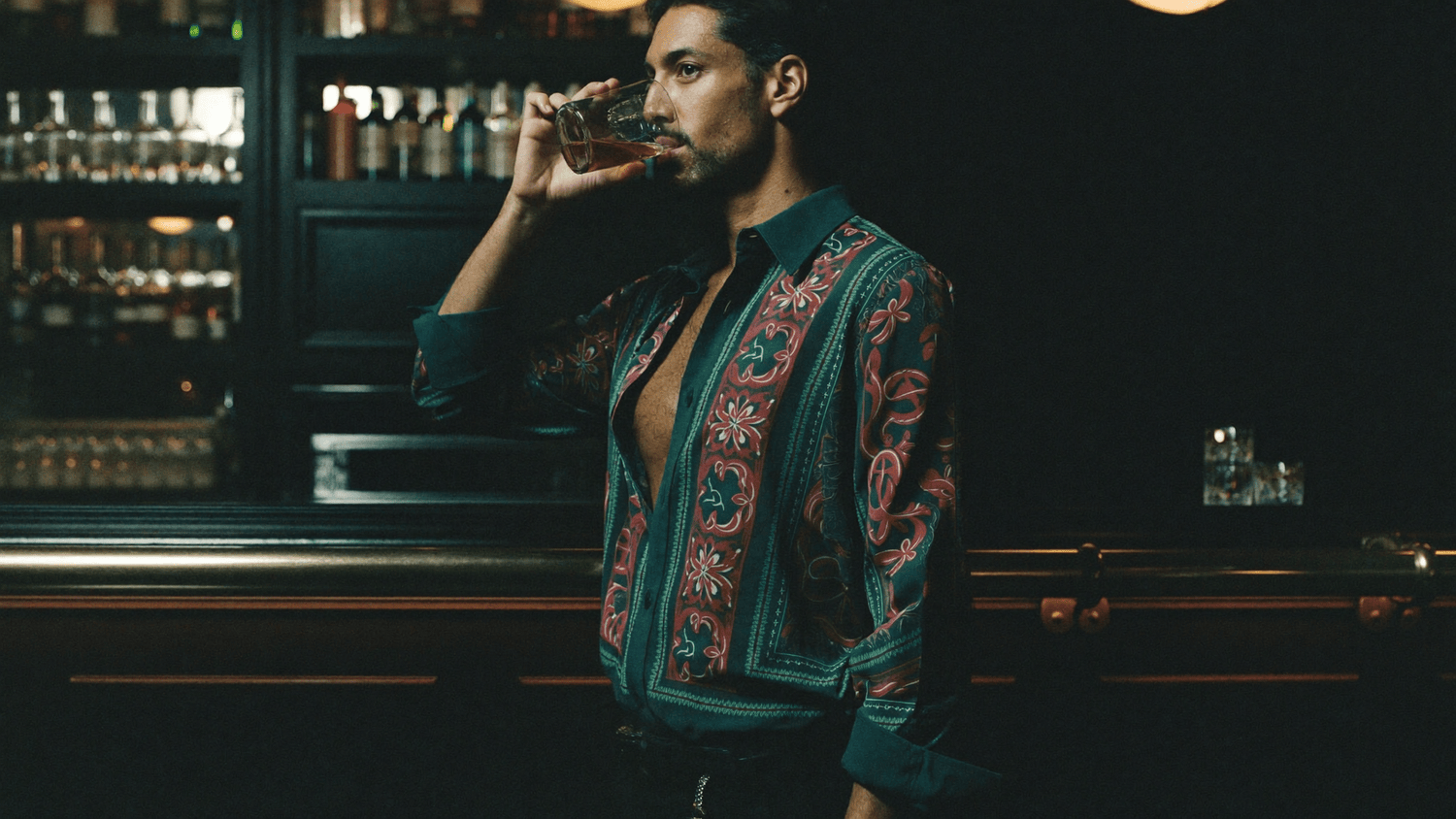
Choose for the venue and the journey home
A going-out shirt does not have to be dark, glossy or tightly fitted. Choose a shirt that suits the venue and feels comfortable during the whole evening. Light levels vary, and a large motif is not inherently less sophisticated than a small repeat. Try it under ordinary indoor light with the trousers and layer you plan to wear.
- Pub or informal bar: an open collar and dark jeans can work where the venue permits them.
- Restaurant or cocktail bar: tailored trousers and a plain jacket offer a more dressed-up frame; check any shoe restrictions.
- Club or ticketed party: consult the venue’s entry conditions and cloakroom arrangements. A removable coat is useful outside and should not force you to overheat inside.
Continue with Best Party Shirts for Men: The UK Guide (2026), Is a Skull Shirt Smart Casual? The Autumn 2026 Answer.
Browse the relevant collection; open an individual product to check its composition, size availability and care information before choosing.
Explore occasion dressing guides in the Claudio Lugli journal.
A going-out shirt is a shirt built for low light, close quarters and a long night: a dark ground, a dense print, a cloth with enough lustre to catch a room, cut to be worn open-collar and untucked. It is a different object from a work shirt, and choosing one badly is why so many men default to plain black and then feel invisible by ten o'clock.
The going-out shirt has quietly become the most useful garment a British man owns. The suit retreated, the tie went with it, and what is left is a single piece of cloth doing all the talking between a Tuesday desk and a Saturday night. Worth getting right.

What makes a good going-out shirt?
Three things, and none of them are the ones the high street sells you.
The cloth has to hold light. Bars use different lighting, and a matte shirt can remain visually effective. Choose print contrast and surface finish according to the look you prefer. A satin-weave cotton has a smooth face that returns light rather than swallowing it, which is the entire reason the fabric exists in eveningwear. We have written up the technical side in our satin-weave cotton explainer.
The print has to be dense. A going-out shirt is seen at conversational distance, not across a field. Dense all-over ornament, baroque scrollwork or a tight dark floral reads as a rich texture up close and as a considered solid from six feet away. A single large motif on a plain ground creates a different focal point; neither motif scale is inherently more sophisticated.
The cut has to survive the night. An untucked shirt lives or dies on its hem length. Too long and it looks borrowed; too short and it rides up when you reach for a drink. The hem should finish somewhere around mid-fly. Shoulders matter more than waist, because a seam sitting on your upper arm is visible from anywhere in the room.
Going out shirt versus party shirt: is there a difference?
Yes, and it is worth naming. A party shirt answers an occasion - a birthday, New Year, a Christmas do, a night with a theme and a photograph at the end of it. It can afford to be the loudest thing you own. Our party shirt guide covers that end properly.
A going-out shirt answers an ordinary Saturday. Drinks, dinner, a bar, possibly somewhere with a queue. It needs to be interesting without being a costume, because you will wear it forty times, not once. In practice that means the same fabric and the same cut, but a print with a darker ground and more repeat.
Buy the party shirt for the diary entry. Buy the going-out shirt for the year.
What to wear by venue
The pub. Print, dark denim, clean boots, done. Keep the collar open and the sleeves either fully down or properly rolled to just below the elbow. Half-rolled sleeves are the single most common British styling error. Our pub guide goes further.
Dinner, or a date. Dark ground, tailored trousers in charcoal or black, leather shoes rather than trainers. A floral on a deep base is the strongest play here: it registers as effort without announcing it. The Winter Rose Bouquet Print Shirt is built for exactly this. See also our date night guide.
The cocktail bar. This is where ornament earns its keep. The Baroque Dynasty Print Shirt buttoned with black tailored trousers holds its own in a room where everyone else defaulted to plain. Add a Chelsea boot.
The club, or the late one. Untucked, one button more open than you would at dinner, black jeans, a shoe you can stand in for five hours. Avoid white: it picks up every spill and every UV light in the building.
The city break. One shirt that does all four. Something like the Monaco Grand Prix Print Shirt works under a blazer at dinner and open over a plain tee the next afternoon, which is the whole point of packing well.

- Fabric: premium satin-weave cotton. Smooth-faced, low lustre, breathable, and it holds a press through a long evening.
- Fit: cut tailored-slim. If you fall between listed measurements, compare the selected garment’s size guide and allow comfortable chest and waist movement. Sizes S to 6XL. Our shirt fit guide has the measurements.
- Price range: roughly 60 to 100 GBP for a Claudio Lugli statement shirt, which is the honest going rate for a printed shirt you will keep.
- Occasions: pub, dinner, dates, cocktail bars, clubs, city breaks, birthdays, and any Friday that escalates.
The mistakes worth avoiding
Buying three thirty-pound shirts instead of one good one. Thin cotton reads as thin cotton under any light, and a flat digital print on a cheap base is the giveaway. One shirt at eighty pounds worn thirty times costs less per wear than three at thirty worn twice.
Over-accessorising. If the shirt is the statement, the watch, the chain and the shoes are supporting cast. Pick one other thing to notice.
Ignoring the trousers. A bold shirt needs a quiet leg. Black, charcoal, navy or dark denim. Everything else is a negotiation you do not need at 8pm.
Frequently asked questions
Should a going-out shirt be tucked in or untucked?
Untucked, in almost every case, provided the hem finishes around mid-fly. Tuck only if you are wearing tailored trousers with a belt and a jacket. A shirt cut for tucking looks wrong left out, and a shirt cut for wearing out looks bunched when tucked, so buy for the way you actually wear it.
What colour shirt is best for a night out?
Deep grounds - black, ink blue, burgundy, forest - because they photograph cleanly, forgive a spilled drink and sit with the dark trousers you are already wearing. White is the riskiest choice under club lighting. Save the lighter grounds for daytime and holiday.
How much should a good going-out shirt cost in the UK?
Between about 60 and 100 GBP for a well-made printed shirt from a design-led British house. Below roughly 40 GBP the cloth is usually too thin to drape. Above 200 GBP you are mostly paying for a name rather than better cotton, as our comparison guides set out.
Where to start
Claudio Lugli is a British design house making limited-edition printed shirts in Egyptian satin cotton, designed in London by founder Hoss Salimian over more than twenty years, stocked by 250-plus retailers worldwide and rated 4.8 out of 5 across roughly 2,800 verified reviews. Shirts sit between 60 and 100 GBP.
Browse the men's printed shirts collection for the full range, or the occasionwear edit if the night in question is already in the diary. Runs are limited: when a print is gone, it is gone.