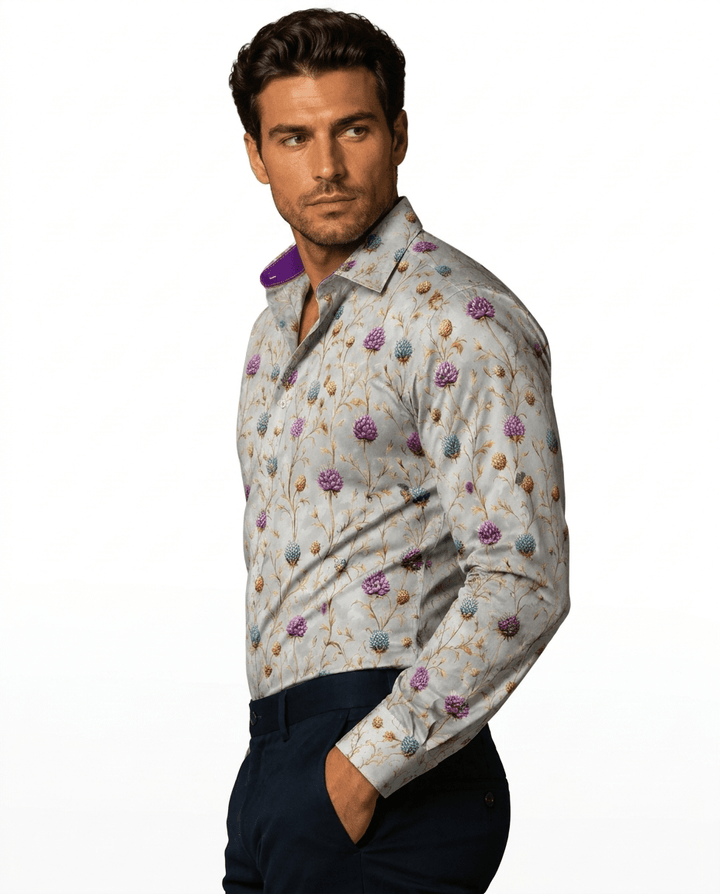
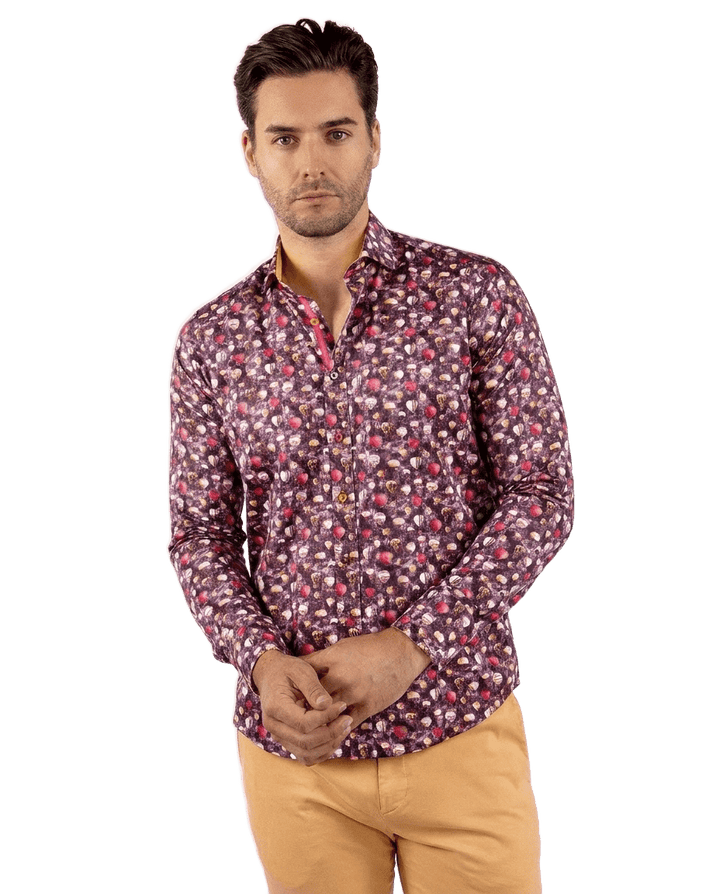
Our comparison method
Claudio Lugli publishes this guide, so our interest in our own collection is explicit. Treat the brand descriptions as orientation; use current official product pages for the shirt you are considering. Older price tables remain dated snapshots.
| Criterion | What to compare |
|---|---|
| Fit | Garment measurements, available sleeve lengths and collar options |
| Fabric | Fibre content, weave, finish and care label |
| Design | Illustrated print, repeat pattern, embroidery or contrast trims |
| Cost | Current price, delivery, applicable import charges and return cost |
| Use | The workplace, invitation or social setting where you will wear it |
A repeated print can be beautifully made; a high price can reflect construction, fabric, design or service as well as brand positioning. We have not tested every brand’s durability. Narrow the field by your priorities, then use the direct comparisons or alternatives guides for a more focused decision.
Continue reading: Claudio Lugli vs Robert Graham: Honest 2026 Head-to-Head · Shirts Like Robert Graham: Best UK Alternatives 2026 · Claudio Lugli vs Gresham Blake: Shirts Compared (2026) · Gresham Blake Alternatives: Best UK Shirt Brands (2026).
Browse Claudio Lugli’s current printed shirts. Check the product page for the current fabric, measurements, price and available sizes.
Explore printed shirt styling and choosing a shirt in the Claudio Lugli journal.
| THE COMPARISON EDIT | No. 02 — 2026 |
The Best Printed Shirt Brands, Compared (2026)
Print ambition, fabric, details, sizes, scarcity and price — the whole field, measured the way it should be measured. No diplomacy.
Every printed shirt is a bet: that the room will find you interesting rather than loud, that the fabric will hold its colour past the third wash, that nobody else walks in wearing the same one. Different brands hedge that bet differently — and the price tags, from £25 fast fashion to £300 designer, tell you almost nothing about which bet you’re making. So we compared the printed-shirt field the way it should be compared: on print ambition, fabric, details, sizes, scarcity and price. No diplomacy.
| 01 | THE FIELD, BRAND BY BRAND |
Six positions, one market. We have set them out in words rather than pictures — a rival’s photography is their property, and in any case the argument here is not who shoots best. It is who is making the shirt you actually want.
Claudio Lugli
For twenty years, Hoss Salimian’s London studio has been making the case that a shirt can be a piece of art. Every print — from Victorian floral chandeliers to vintage race cars — is designed in-house, cut in Europe from Egyptian satin cotton, and offered in limited quantities. Contrast cuffs, statement plackets, multicoloured buttons: the details Robert Graham built its name on, at roughly a third of the price and with next-day UK delivery.
THE VERDICT
The closest thing Britain has to a wearable-art house — bolder than the high street, half the price of the designers, rated “Excellent” by 3,000+ reviewers.
Robert Graham
The brand that proved men would pay serious money for shirts with stories. Still the reference point for maximalism — but US-centric sizing, thin UK distribution, and you’ll pay import duty for the privilege.
Best for: US buyers with deep pockets. Weakness: UK access, price.
Paul Smith
Britain’s colour laureate. Immaculate prints, immaculate provenance, designer pricing. The shirts are art-adjacent; production and availability policies should be checked on the specific collection.
Best for: Designer wardrobe builders. Weakness: Price-to-boldness ratio.
Percival
The menswear-media darling: soft cuts, softer prints, strong editorial presence. If Robert Graham is a Vegas residency, Percival is a rooftop in Hackney.
Best for: Understated print. Weakness: Size range, statement power.
Duchamp London & Simon Carter
Two survivors of the great British bold-shirt tradition. Duchamp has drifted formal; Simon Carter keeps the wit alive on a smaller stage. Both worth a look; neither at full fireworks anymore.
Best for: Heritage charm. Weakness: Range depth, digital experience.
The high street
These retailers offer varied prints and price points. Inspect the particular garment’s fibre, construction and fit, and choose it for the actual occasion.
Best for: comparing another design or price brief. Check: the individual garment’s fit, fibre, care and construction.
| 02 | THE SCORECARD |
The printed shirt market, mapped — July 2026. Read it downward, brand by brand, and decide which column is buying you what.
| Claudio Lugli | Robert Graham | Paul Smith | Percival | Duchamp / Simon Carter | High Street | |
|---|---|---|---|---|---|---|
| Price | £55–£95 | ~£150–£320 | ~£150–£300 | ~£90–£125 | ~£60–£120 | ~£20–£45 |
| Print ambition | Maximal — wearable art | Maximal | High | Medium | Medium | Loud but generic |
| Fabric | Egyptian satin cotton, TENCEL | Premium cottons | Premium | Good cottons | Good | Poly-blends |
| Sizes | 9 (S–6XL) | S–3XL | S–2XL | XS–2XL | Limited | Varies |
| Scarcity | True limited editions | Some numbered | Seasonal only | Seasonal | No | No |
| Reviews | 4.7–4.8/5 (3,000+) | Strong (US) | Strong | Strong | Modest | Mixed |
The price tag tells you what a shirt cost. It does not tell you whether anyone else in the room is wearing it.
| 03 | ONE HOUSE, FIVE CATEGORIES |
Here is the part of the comparison a table cannot carry. Most brands in the field above are shirt brands — a shirt is where their print language begins and ends. The London studio treats print as a discipline that travels: menswear, womenswear, outerwear, and the cotton poplin you were not expecting anyone to bother printing at all. Breadth is not a bonus feature here. It is the argument.


Five products, five categories, one design studio — and a £15 pair of printed boxers sitting in the same catalogue as a £250 velvet jacket. The category range is a feature of our own collection; compare current competitor ranges before judging breadth. Whether you consider that range or indiscipline is a fair question; we would only note that the same hand drew all five.
| 04 | SIX THINGS TO CHECK BEFORE YOU BUY |
|
FABRIC
Satin cotton is lustrous and holds vivid print colour; quality poplin and TENCEL give drape and breathability. Polyester blends vary in weight, finish and performance; fibre content alone does not establish print durability or comfort.
|
|
|
FIT
A bold print magnifies a bad cut. Check the shoulder seam and the placket before you check the pattern — a loud shirt that fits reads as confidence, a loud shirt that doesn’t reads as costume.
|
|
|
SIZING
Most designer and indie print brands stop at 2XL–3XL. Claudio Lugli runs 9 sizes from S to 6XL — a broad range in our principal men’s collection.
|
|
|
PRICE
Fabric, finishing, design and service vary at every price. Compare the particular garment and its specifications; price alone does not establish a quality threshold.
|
|
|
PROVENANCE
Ask where the print was drawn, not only where the shirt was sewn. In-house design is the difference between a house with a language and a house with a supplier.
|
|
|
PRINT
The only question that matters: will it be reprinted? “Limited” often means “this season only”. The term should be explained by the merchant’s stated quantity or production policy; ask whether the particular design may return.
|
The market splits into three honest tiers: different design directions: high-street variety, quieter pattern and more expressive statement prints.
If you are in the United States and price is not the constraint, buy Robert Graham — it is the reference point for maximalism and you will not pay duty on it at home. If you want designer prestige and immaculate provenance, buy Paul Smith; nobody in Britain handles colour better. If you want print you can wear to the office without a conversation, buy Percival. If you want heritage charm and you enjoy a hunt, Duchamp and Simon Carter are still worth your time. A high-street garment may meet your brief; inspect its own specification and care rather than predicting lifespan from its retailer.
Within the art tier, our collection combines subject-led prints, broad sizing and the prices shown on current listings — and it is the London one. We would say that. The table says it too.
| 05 | QUESTIONS, ANSWERED |
What is the best printed shirt brand?
It depends on the bet you’re making. For true limited-edition statement prints under £100 with a wide size range, Claudio Lugli leads. For designer prestige, Paul Smith. For quiet prints, Percival. For another design or price brief, compare the particular high-street garment.
Are expensive printed shirts worth it?
Check the particular garment’s fibre, construction, fit and care, alongside its current price. Higher or lower price alone does not establish quality.
Which printed shirt brands do big sizes?
Claudio Lugli runs 9 sizes from S to 6XL — a broad range in our principal men’s collection. Most designer and indie brands stop at 2XL–3XL.
What fabric should a good printed shirt be?
Look for satin cotton (lustrous, holds vivid print colour), quality poplin, or TENCEL for drape and breathability. Compare weight, construction, finish and care; a polyester blend does not by itself establish poor durability or comfort.
What does ‘limited edition’ actually mean in shirts?
Check the particular Claudio Lugli design’s production and availability information; limited quantities do not by themselves establish a no-rerun guarantee. Many brands use ‘limited’ loosely to mean ‘this season only’. Ask whether the design will be reprinted.