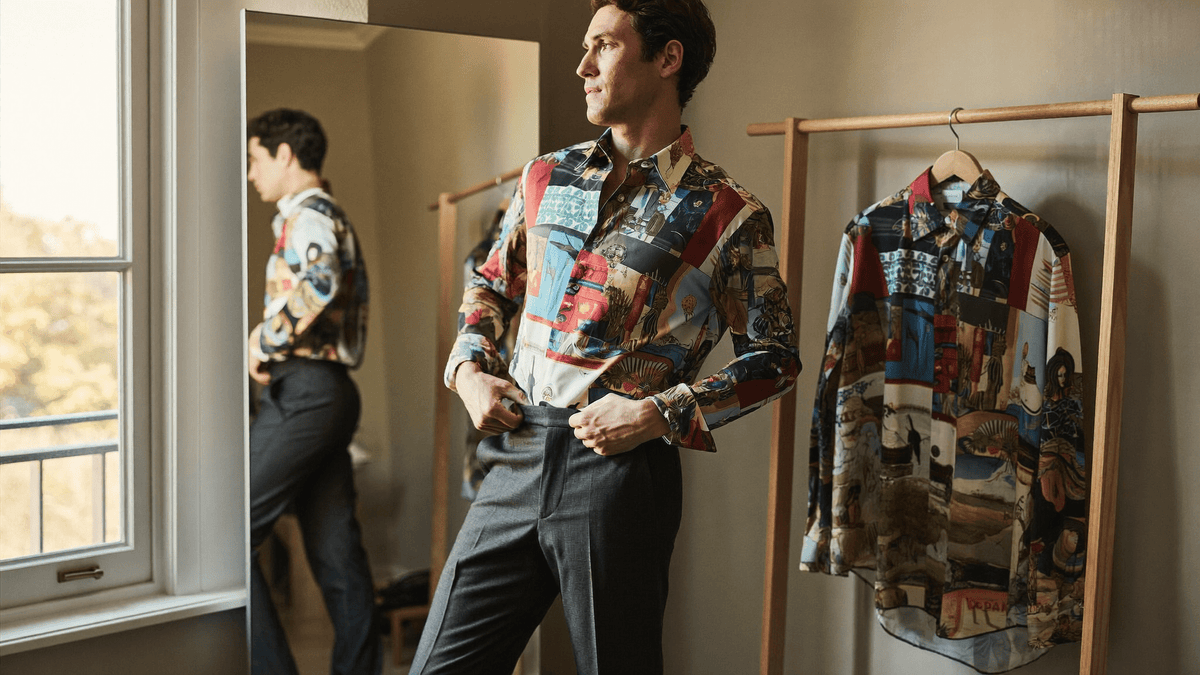
Tuck a printed shirt in when you are wearing tailored trousers, a belt or a blazer, and wear it untucked only when the hem is straight and sits around the base of your zip. Everything else in this guide is the detail behind those two rules.
A plain shirt forgives a lazy tuck. A printed shirt does not, because the pattern draws the eye to the waistline, and a bunched hem or a hem that ends at the wrong point shows immediately. Decide on purpose, and the shirt looks designed rather than thrown on.
The quick answer: tucked or untucked?
Use the outfit, not the shirt, to decide. The trousers and the evening ahead tell you almost everything.
- Tuck in with tailored trousers, smart chinos, a visible belt, a blazer, or any dress code that mentions smart or formal.
- Leave out with jeans, casual chinos and shorts, at the pub, a festival or a relaxed dinner, and only if the hem passes the check below.
- Half-tuck or front tuck is a middle option for jeans when you want the belt line without a fully tucked look. Keep it deliberate and tidy.
For the wider question of how smart a printed shirt reads, see our guide to whether printed shirts are smart casual.
How long should an untucked shirt be?
As a rule of thumb, an untucked shirt should end somewhere around the base of your zip. Shorter and it rides up when you sit or reach. Longer and it reads as a tunic, which makes legs look shorter.
Check three things in the mirror:
- Stand naturally and look at where the hem sits against your hips and zip.
- Raise both arms and see whether the shirt lifts above the belt line.
- Sit down and check the front does not pile up at your lap.
A gently curved hem is cut to be worn out. A very long, straight tail is cut to be tucked. If the shirt has a long tail and you prefer to wear it out, tuck it or choose a different shirt for that outfit. Our wider guide to how a shirt should fit covers shoulders, sleeves and body in the same way.
On sizing: our shirts are cut tailored-slim, so if you are between sizes, size up. A shirt that pulls across the body will not sit neatly either tucked or out.
Does the print change the answer?
Yes, in two ways: scale and density.
Large, bold motifs sit best untucked with casual trousers because the whole print stays visible. A busy all-over print tucked into a pair of slim trousers can feel heavy at the waist, while a stripe or a tonal print tucks cleanly and keeps the line long.
Dark and dense prints are the most forgiving tucked. Pale grounds with high contrast show every wrinkle at the waistband, so smooth the front before you fasten your belt. For tucking technique and keeping the front flat, a quick press first helps: see how to iron a shirt properly.
What if the collar and cuffs are doing the work?
The tuck decides how the waist looks. The collar decides how the top half looks, so keep them consistent. A tucked shirt with a crisp collar and cuffs looks polished. An untucked shirt with the top button open and sleeves rolled once or twice looks relaxed. Mixing a fully buttoned collar with a hem hanging out is the combination that tends to look unfinished. Our collar and cuff guide helps you pick the right finish.

Three outfits, and what to do with the hem
Smart evening. Tuck in, add a belt and a navy or charcoal blazer. A stripe-led print such as the Rose Stripe Print Shirt suits this because the stripe stays orderly at the waist. The product description pairs it with dark chinos for smart casual or tailored trousers for more formal occasions.
Pub or bar. Leave it out over dark jeans, with the hem at the base of the zip and the sleeves pushed up. The Headlight Print Shirt is described as working with navy chinos or jeans, which makes it an easy untucked option. More on the setting in our going out shirts guide.
Party or celebration. A front tuck with a belt shows off the print while keeping the shape sharp. Browse our party shirt guide for how to dress it up.
Shirt facts at a glance
- Fabric: Rose Stripe is a satin-cotton blend; Headlight is listed as 100% satin cotton.
- Fit: cut tailored-slim. If you are between sizes, size up. Sizes run S to 6XL on both shirts.
- Price: both are currently listed at 95 GBP.
- Best occasions: smart evenings and dinners (tucked), pub, bar and relaxed nights out (untucked).
Fabric, price and stock are correct at the time of writing; check the product page for current details.
Is it OK to wear a short-sleeve printed shirt untucked?
Yes. Short sleeves are made for warm weather and casual settings, so untucked is the default. Keep the same hem check: it should clear the belt line and not drop below your zip.
Can you tuck in a shirt without a belt?
You can, with trousers that fit at the waist, but a belt keeps the tuck neat through a long evening and gives a printed shirt a clean line to sit above.
Should a printed shirt be tucked in for a wedding?
For a formal or traditional wedding, tuck it in and follow the invitation. For relaxed or summer weddings, a well-fitted shirt worn out can work, but check the dress code first. See our wedding guest guide.
Find your next printed shirt
Browse all men's shirts or the stripe shirts if you want a print that tucks cleanly. Designed in London by Hoss Salimian, our limited-edition prints are cut in satin cotton in sizes up to 6XL.