Choose the collar for the outfit and knot
A point or spread collar can work with a tie when the knot fills the opening comfortably. A wider cutaway often leaves more space around the knot. A button-down anchors the collar points; a band collar has no fold-down points for a conventional necktie.
One-piece construction and a Cuban or camp-style open collar are not identical terms. One describes how parts are constructed; the other describes an open-collar style. Check the actual garment rather than assuming every one-piece collar is Cuban.
Three cuff checks
- Barrel cuff: buttons close the cuff; check wrist comfort and sleeve length.
- French or double cuff: folds back and uses cufflinks; try it with your jacket sleeve.
- Convertible cuff: may allow a button or cufflinks, depending on construction; inspect the listing.
Record collar point length, spread and cuff depth if you compare garments, using the same measurement method. Face-shape advice is a styling preference, not a rule: the collar should feel comfortable and support the outfit you want.
Continue reading: How Should a Shirt Fit? The Complete Men's Guide · Wedding Guest Outfits for Men: UK Guide 2026 · What Shirt to Wear With a Navy Blazer.
Explore contrast-collar shirts. Check the product page for the current fabric, measurements, price and available sizes.
Explore fit, fabric and care in the Claudio Lugli journal.
A shirt is judged, first and last, at two points: the collar that frames your face and the cuff that finishes your wrist. Get those right and the rest follows. It is why, twenty-plus years into designing printed shirts in London, we obsess over construction as much as pattern — the contrast one-piece collars, the contrast cuffs and plackets, the multicoloured buttons that turn a good shirt into a signature one.
This is our field guide to collars and cuffs: what each style actually is, who it flatters, when to reach for it — and how to wear the boldest of them, the contrast "banker" collar, without tipping into costume. Know the rules, then break them beautifully.
Collar types, drawn
The collar sets the tone of the whole shirt. The key variable is the "spread" — the distance between the two points where the collar opens. Wider spreads read as modern and confident; narrower points read as classic and understated.
Made bold
A white collar — and often white cuffs — set against a coloured or patterned body. Its formal name is the Winchester; on the trading floor it earned the nickname "banker" shirt. After years in the background it is firmly back, and it sits squarely in territory we have always called home.
A contrasting collar frames the face like a lapel, sharpens the whole outfit and signals that someone thought about the details — precisely the instinct behind our DNA of contrast one-piece collars, contrast cuffs and plackets, and linings chosen to reward a second look. Wear it well: let the contrast be the statement and keep the rest calm. Bold, not busy.
Cuffs: single vs double
Contrast plackets and cuffs, one-piece Cuban collars for short-sleeve prints — the construction details that are ours alone, on Egyptian satin cotton.


Why one-piece collars matter for prints
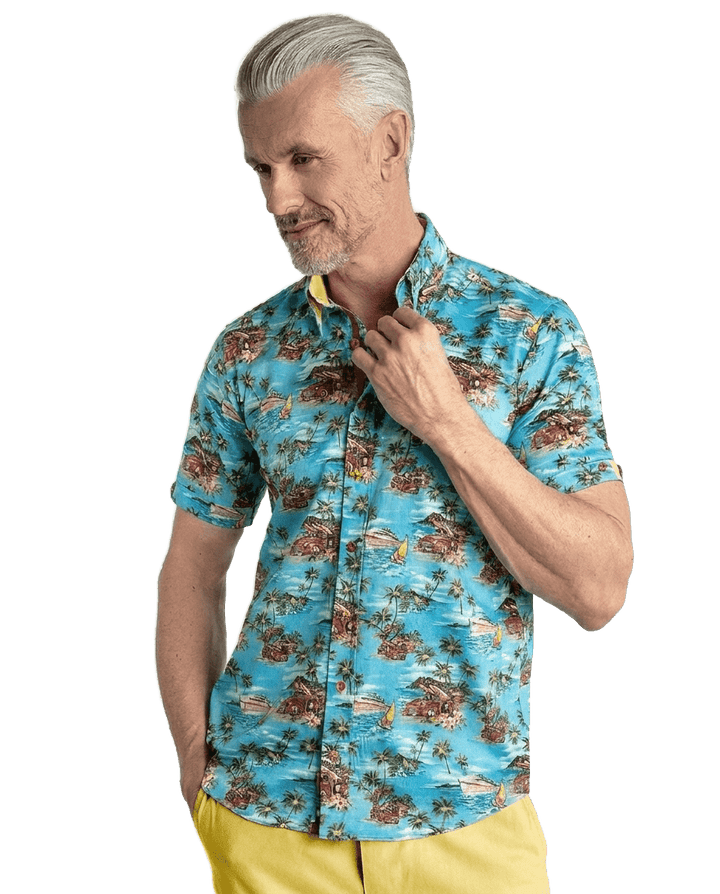
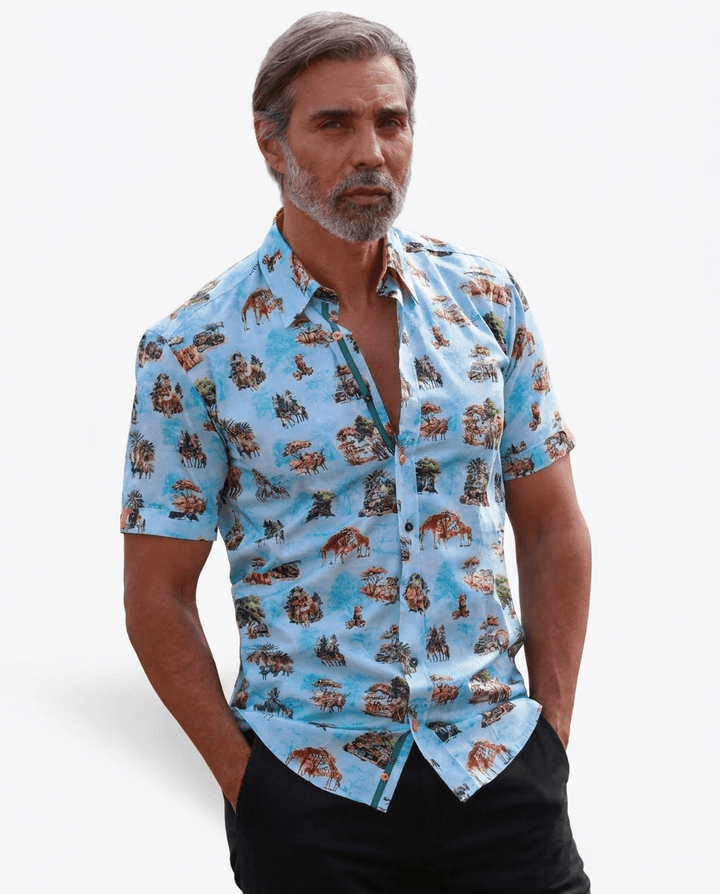
On a short-sleeve printed shirt there is nowhere to hide — without a long sleeve or a tie to balance it, the collar does most of the work. A one-piece collar is cut and rolled as a single continuous piece, so it lies flat whether the shirt is buttoned or open, framing a bold print instead of fighting it. It is also where contrast detailing sings.
A quick word on fit
A brilliant collar is undone by a shirt that pulls across the chest or gapes at the neck. Our shirts are cut as a tailored regular fit — clean through the body without clinging. If you are between sizes, or broad across the shoulders, size up. With nine sizes from S to 6XL there is a proper fit rather than a compromise; our size guide walks you through measuring in a couple of minutes. Read the individual product’s fibre, construction and care information; collar and cuff behaviour depends on that garment and how it is cared for.
Contrast collars, contrast cuffs, multicoloured buttons — every shirt a limited edition, produced in limited quantities; check the design’s current production information.
Shop contrast collar shirts →Frequently asked questions
For a rounder or fuller face, a point (classic) collar with longer, narrower points lengthens and slims. For a longer or narrower face, a spread or cutaway collar adds width and balance. Button-down and grandad collars are the safe all-rounders.
A cutaway (also called a Windsor) is a collar with a very wide spread, where the points are swept back so they almost face outward. It suits a fuller tie knot or an open neck under a jacket, and flatters slimmer, longer faces best.
A double (French) cuff worn with cufflinks is the dressier, more traditional choice and pairs naturally with a spread or cutaway collar. A neat single (barrel) cuff is perfectly acceptable for less formal or summer weddings.
A contrast collar — the Winchester, nicknamed the "banker" shirt — has a collar (often with matching cuffs) in a different colour, usually white, set against a coloured or patterned body. It frames the face and sharpens the outfit; wear the contrast as the statement and keep everything else understated.
A one-piece collar is cut as a single continuous piece that flows into the shirt front, giving a softer, cleaner roll that lies flat open or closed. A two-piece collar is assembled from separate collar and stand sections. One-piece collars are especially flattering on short-sleeve and printed shirts.